


Double-board-certified plastic surgeon Dr. David Rapaport has over three decades’ experience sculpting and contouring NYC patients’ thighs with thigh liposuction. This procedure removes excess fat from the thighs, resulting in improved proportions.
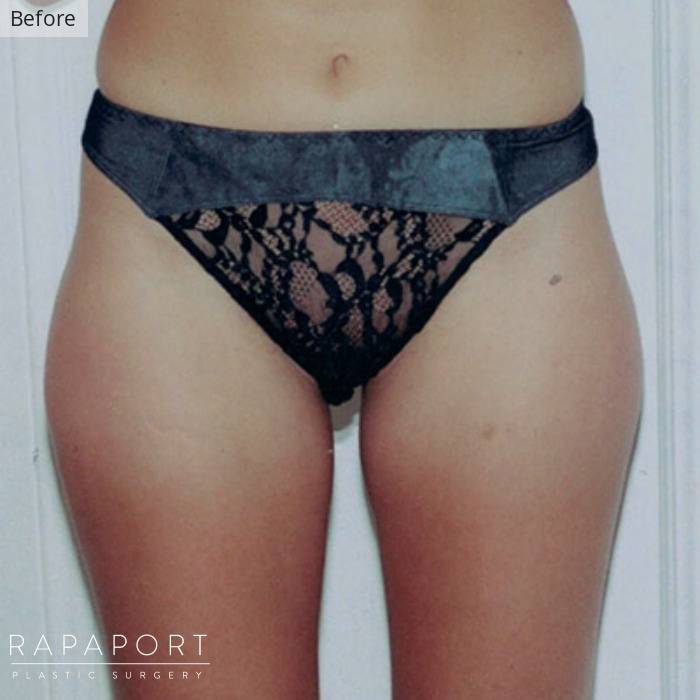
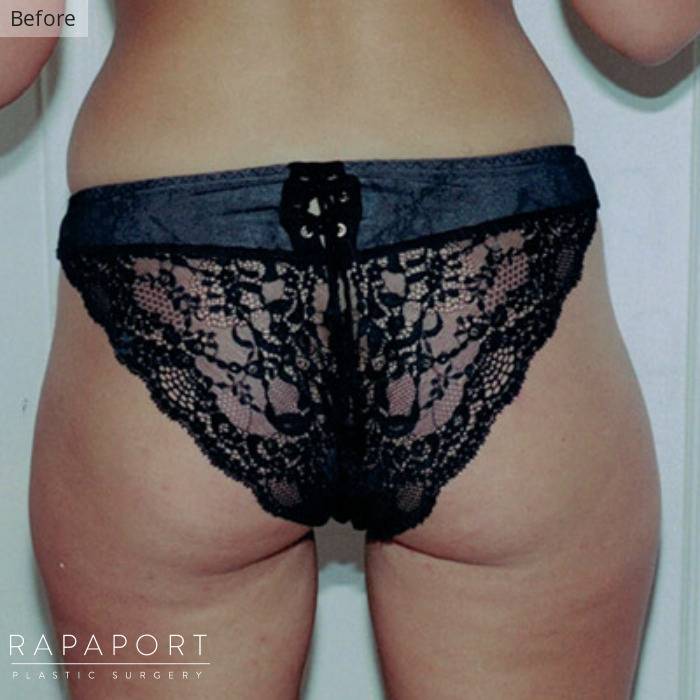
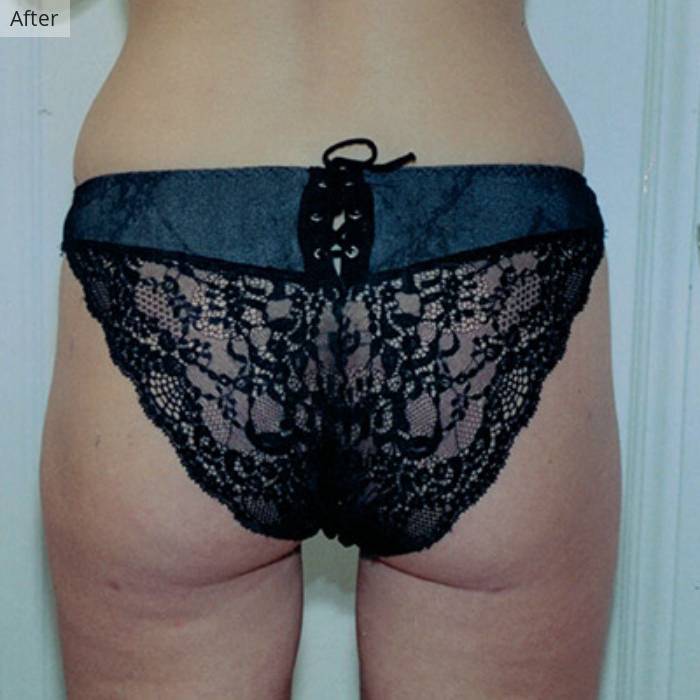
Look over Dr. Rapaport’s incredibly natural-looking results in our before-and-after thigh liposuction gallery here.
To learn more about thigh liposuction and what it can do for you, set up a personalized consultation with Dr. Rapaport today. Call us or fill out our contact form. Our NYC fully-accredited surgical facility is very close to The Frick Collection art museum, in Central Park, Ralph Lauren, and Brasserie Cognac.
Thigh Liposuction Overview
The thighs are among the most commonly treated areas for liposuction. More often than not, thigh liposuction is combined with other areas, including the lower abdomen and waist.
Because of their anatomy, the inner and outer thighs are each very different areas and should therefore be looked at separately.
Thigh Liposuction Results

BEFORE
AFTER

BEFORE
AFTER
BEFORE
AFTER
BEFORE
AFTER
*Individual results may vary.
A Pioneer In Plastic Surgery
Dr. Rapaport: The Perfect Choice for NYC Thigh Liposuction
To achieve contoured thighs safely and effectively, New York City patients prefer board-certified plastic surgeon Dr. David Rapaport. Dr. Rapaport is considered by many in the know to be the best liposuction surgeon in NYC, and he consistently delivers natural-looking results. His numerous five-star online reviews speak for themselves.
Dr. Rapaport conducts all thigh liposuction procedures in our high-quality Quad A accredited New York City facility at 905 5th Ave., at the corner of 72nd St. We also see patients for consultations at our flagship location, Aethos, at 50 E. 61st.
Because of Dr. Rapaport’s high degree of surgical skill and meticulous attention to detail, as well as good fortune he has never experienced a patient death (as of the date of this writing in December 2025 Dr. Rapaport has not experienced any death of a cosmetic patient during or following any surgical procedure he has performed) or any form of serious complication during or following a liposuction procedure. He has been honored by New York magazine as a Top NYC Plastic Surgeon and by Castle Connolly as a Top Doctor since 2016.
Our Accreditations













Learn More About Inner and Outer Thigh Liposuction
Both in terms of anatomy as well as aesthetic considerations, the inner and outer thighs are radically different from one another. The inner thigh fat generally fills the highest portion of the inner thigh and can be seen both from the front and the back. The skin overlying this fat is almost always thin and fairly delicate, being in the upper inner thigh. It’s also crucial to note that this skin and fat mass tends to fall downward and inward when one is standing up. This is a very important consideration when performing liposuction because the unmasked impending laxity component of the inner thighs can become severe if aggressive liposuction is performed without taking it into consideration. It is for this reason that Dr. Rapaport has a low threshold for recommending internal tightening generally with Renuvion in order to fend off that impending laxity of the inner thighs. He will likely also recommend Sofwave either before or after the liposuction procedure on patients with thin, delicate skin for whom crepiness or wrinkles are a consideration that they want to prevent or improve.
Excess fat in the inner thighs can be considered less than aesthetically optimal in shorts, a short skirt, or a bikini. It can also result in functional challenges due to the inner thighs rubbing together, including chafing when running. Genetics will determine how many fat cells are in one’s inner thigh area, and that, coupled with the patient’s actual weight, will determine to what extent inner thigh fatty disproportion may or may not be a problem.
In light of the anatomic considerations outlined above, when planning to perform liposuction on the inner thigh, one must first look at existing laxity and how that will be altered. One must then also consider impending laxity, which means even if the inner thigh does not look loose currently, it may after the fat is removed. This is because the fat essentially acts as stuffing in that tissue. In much the same way, as removing stuffing from a pillow will make the surface of the pillow appear more ripple and loose, so will tissues emptied of their fat make the skin appear more folded, hanging, and loose.
It is for this reason that inner thigh liposuction is often recommended to be performed together with an internal tightening procedure (usually Renuvion) and followed by an external tightening procedure (usually Sofwave).
At our NYC Quad A fully accredited facility, we utilize the very best technologies for tightening. The internal tissue is best tightened with Renuvion, which is performed at the same time as the liposuction. This radiofrequency-ignited helium plasma treatment produces a very short but significant heat application to the interstices of the tissue after the fat has been removed. This results in the formation of new collagen, which tightens that area of tissue.
The skin itself needs to be assessed separately for its degree of current crepiness and impending crepiness, which is the worst sign of skin laxity. These problems are currently best treated with Sofwave™. This non-invasive ultrasound-based technology introduces heat into the dermis and only the dermis (specifically 1.5 mm deep), encouraging the skin to thicken and thereby reducing the appearance of crepiness.
So this is the new ‘trifecta’ as it applies to liposuction. While it was once liposuction with BodyTite and Morpheus8, now we prefer liposuction with Renuvion and Sofwave™.
Renuvion, we find, is safer and more powerful than BodyTite and Sofwave™ because it is completely non-invasive. We find it does not come with the potential risks of needling technologies such as Morpheus8, which include burns, scarring, and, most frighteningly perhaps, fat loss. When this “stuffing” is reduced, it defeats the entire purpose of tightening, because it only makes things looser.
Dr. Rapaport no longer performs the inner thigh lift, mainly because it is an operation that has a very significant risk of complications. In his experience with inner thigh lifts, he has never had a complication, and because of this, he decided to quit while he was ahead. An open wound after an inner thigh lift is a nasty situation because it is not far from the anus. It generally needs to be left open to heal secondarily, which can take weeks and be a real letdown for the patient.
Therefore, Dr. Rapaport does everything in his power to improve the inner thigh without a lift for his NYC patients. If the patient clearly needs a lift to get the level of satisfaction they seek, he will refer them elsewhere.
As opposed to the inner thigh, where impending laxity is a big issue, the thicker tissues of the outer thigh provide a greater elastic recoil in the majority of patients. Therefore, for younger New York City patients undergoing liposuction of the outer thigh, most cases do not require advanced technology such as Renuvion to treat impending laxity.
The exceptions will be older patients who already demonstrate some degree of laxity, as well as patients who have severe relative fatty excess. In those cases, it is clear that when substantially reducing a large bulge, there is no possibility but to have laxity. Those cases are treated with Renuvion, sometimes accompanied by Vaser ultrasound and assisted liposuction during the liposuction procedure.
Outer thighs are a critical component in determining the proportions of a woman’s lower body, and these proportions are all about relationships between the waist, hips, and outer thighs. Because when the eye is looking at a woman’s body from behind, it is not seeing each area individually, but rather seeing the curves created by the integration of all the areas. For example, if a woman has moderate protrusion of her hip area and outer thigh area but only chooses to treat one, then the untreated area will immediately look disproportionately large, more than it did before the procedure.
Another example would be if someone has borderline bulges in the hip area and comes in for outer thigh liposuction, it is extremely likely that if we treat the outer thigh only and leave the hip alone, the borderline hip will now look larger, because it is no longer in harmony with the bulge of the outer thigh. In the before and after image below, you can see what it can look like when liposuction is performed on just the hips or just the outer thighs alone.
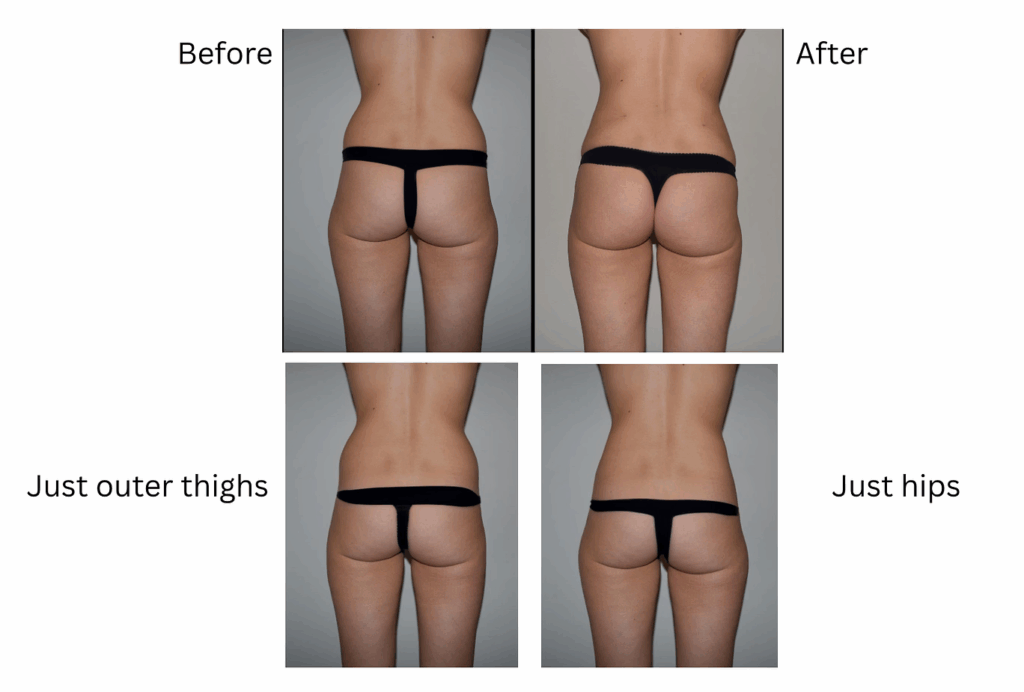
When people are looking at themselves in the mirror and assessing themselves, they often focus only on the worst fatty bulge rather than their overall proportions. They also don’t usually spend time looking at themselves from behind because of the reality of most people‘s home mirrors… Therefore it is doubly important to educate patients during their consultation to recognize how they appear from behind, and what their proportions look like because more often than not the recommendation will be to treat more than one area in order to improve overall proportions.
Interesting fact: Studies designed to quantify engagement of eyes with bodies have shown that men spend much more time looking at women walking away from them than walking towards them, the simple reason being that they can! A man cannot stare at a woman’s chest as she is walking towards him, because she can see that he is doing so, and this is not socially acceptable. However, when a woman is walking away, she cannot see how long the man is staring. Therefore, it is of value to assess the body from the rear and to always think about the harmony of one’s proportions rather than focusing solely on one specific area.
The best candidates for thigh liposuction in New York are patients who are unhappy with stubborn excess fat in their inner or outer thighs, as well as fatty disproportions. The procedure is best for patients who are in search of focused contouring rather than weight loss. Weight loss alone will, of course, not affect fatty proportions, but will just shrink the current proportions or disproportions. Additionally, patients must be in good overall health to be considered ideal candidates.
Thigh liposuction from Dr. Rapaport involves advanced liposuction techniques. Any of the following may be performed:
Tumescent Liposuction – This features injection of tumescent fluid, which reduces bleeding, numbs the region, and temporarily increases the size of fat cells to make removal easier.
Power-Assisted Liposuction (PAL) – Dr. Rapaport uses an oscillating powered cannula, reducing post-surgical bruising and improving the efficiency of fat removal, especially in fibrous areas.
Equalization – Dr. Rapaport utilizes a basket cannula with no suction, internally moving around micro-fat cells within an area to create exceedingly smooth thigh liposuction results.
VASERlipo – This form of UAL (ultrasound-assisted liposuction) breaks down the fat cells, helping to expedite removal.
Thigh liposuction usually involves administering twilight anesthesia either by an anesthesiologist with an IV or via oral medications when a limited amount of areas are being treated, in appropriate patients. Dr. Rapaport then creates very small incisions in well-camouflaged areas. He uses a fine cannula to disperse numbing solution, and then precisely removes the excess fat using a variety of fine liposuction cannulas. Finally, he places a single suture in each incision for closure.
After thigh liposuction from Dr. Rapaport, patients will need to rest and recover. Swelling and bruising is normal and will fade in time. Patients must wear compression garments to encourage the healing process.
Patients can usually return to work in a matter of 2-3 days, depending on the nature of their job. Return to stretching, and the gym is generally allowed and encouraged after only 2 to 3 days! Narcotics are not prescribed following liposuction because they are simply not needed. Ibuprofen or similar agents suffice. An in-person postoperative follow-up, occurs approximately one week after the procedure. There is typically a virtual one-month touch base to confirm that all healing is occurring normally. There can be a period of up to two or three months where areas, including the inner thigh and lower abdomen, may have variable amounts of bumpiness during the recovery, and this is reviewed in detail with all patients. Well, results are generally quite apparent after his little as three or four weeks. Dr. Rappaport likes to wait a full three months before doing a formal assessment of results and considering any possible touchups because it takes that long before tiny irregularities can settle and disappear.
The price of thigh liposuction in NYC may be impacted by a number of factors. These include the area of the thigh being contoured, the techniques Dr. Rapaport performs, and the time required to perform the operation. Price may also be affected by anesthesia fees and the amount of fat removed from the thighs.
While Dr. Rapaport makes every effort to provide excellent value for his services, they nonetheless may seem initially out of reach to some people. For this reason, we work with a handful of reputable financing companies, and we make every effort to help you achieve your goals in a financially tolerable manner.
These financing companies include Cherry medical financing, CareCredit medical financing, and PatientFi. They provide a variety of financing plans to help you find the ideal option for your needs and goals.
Schedule Your Thigh Liposuction Consultation Today
Call (212) 249-9955 or fill out our contact form to arrange your thigh liposuction consultation with Dr. Rapaport. For out-of-town patients, our Manhattan clinic is near hotels like Affinia Gardens, The Surrey Hotel, and The Lowell.



