Expert Guide to Breast Implants: Incisions, Safety Tips
February 3, 2026
Breast augmentation remains one of the most sought-after cosmetic procedures worldwide. If you’re considering breast implants or simply curious about the process, it’s essential to understand the key terminology, surgical options, and potential risks involved. Drawing on over 30 years of experience as a board-certified plastic surgeon, Dr. David Rapaport, located in New York City, breaks down everything you need to know about breast implants—from sizing and incision choices to avoiding common complications like capsular contracture.
Understanding Breast Implant Terminology
Before diving into the procedure itself, it’s important to grasp some foundational terms used in breast augmentation.
The Nipple-Areolar Complex
When surgeons refer to the nipple in breast augmentation, they often mean the nipple-areolar complex (NAC). This includes the nipple itself—the protruding center—and the areola, which is the pigmented skin surrounding the nipple with a distinct texture. Understanding this is crucial because incision placement often relates to this area.
Breast Volume (Measured in cc’s)
Breast volume is the amount of space the breast occupies and is typically measured in cubic centimeters (cc). When referring to implants, volume indicates how much space the implant will take inside the breast—essentially, how much water it would displace if removed and submerged. This is the key measurement when discussing implant size.
Skin Envelope
A vital yet often overlooked concept is the “skin envelope.” This refers to the skin container that holds the breast tissue and implant. The skin envelope size can vary independently of volume. For example, a woman might have a large skin envelope with a small breast volume, resulting in sagging or “deflated” breasts. Conversely, a small skin envelope with a large implant volume creates a tight, perky breast but also increases tension on the skin, potentially causing stretch marks or other skin issues.
Base Diameter
The base diameter is the width of the breast at its base and is the most critical measurement for implant sizing. This measurement ensures the implant fits the natural breast footprint, creating a balanced and natural appearance. Incorrect base diameter sizing can cause the nipple to be off-center or the implant to look unnatural.
Additional Terms
- Skin Pinch: The amount of skin that can be pinched, especially in the upper pole (upper breast area), which helps assess skin tightness.
- Lower Pole: Breast tissue below the nipple.
- Upper Pole: The tissue above the nipple.
- Inframammary Fold (IMF): The natural crease beneath the breast where the breast meets the chest wall.
- Pseudoptosis: A condition where the nipple remains in a good position, but excess skin hangs below the IMF, giving a saggy appearance.
Who Is an Ideal Candidate for Simple Breast Augmentation?
Simple breast augmentation is best suited for women who want to increase breast size but do not require a lift. In these cases, the nipples are in a reasonable position, and the skin envelope is adequate to support the implants without excessive sagging. Women with significant sagging (ptosis) usually require a mastopexy or breast lift combined with implants.
Incision Choices for Breast Augmentation
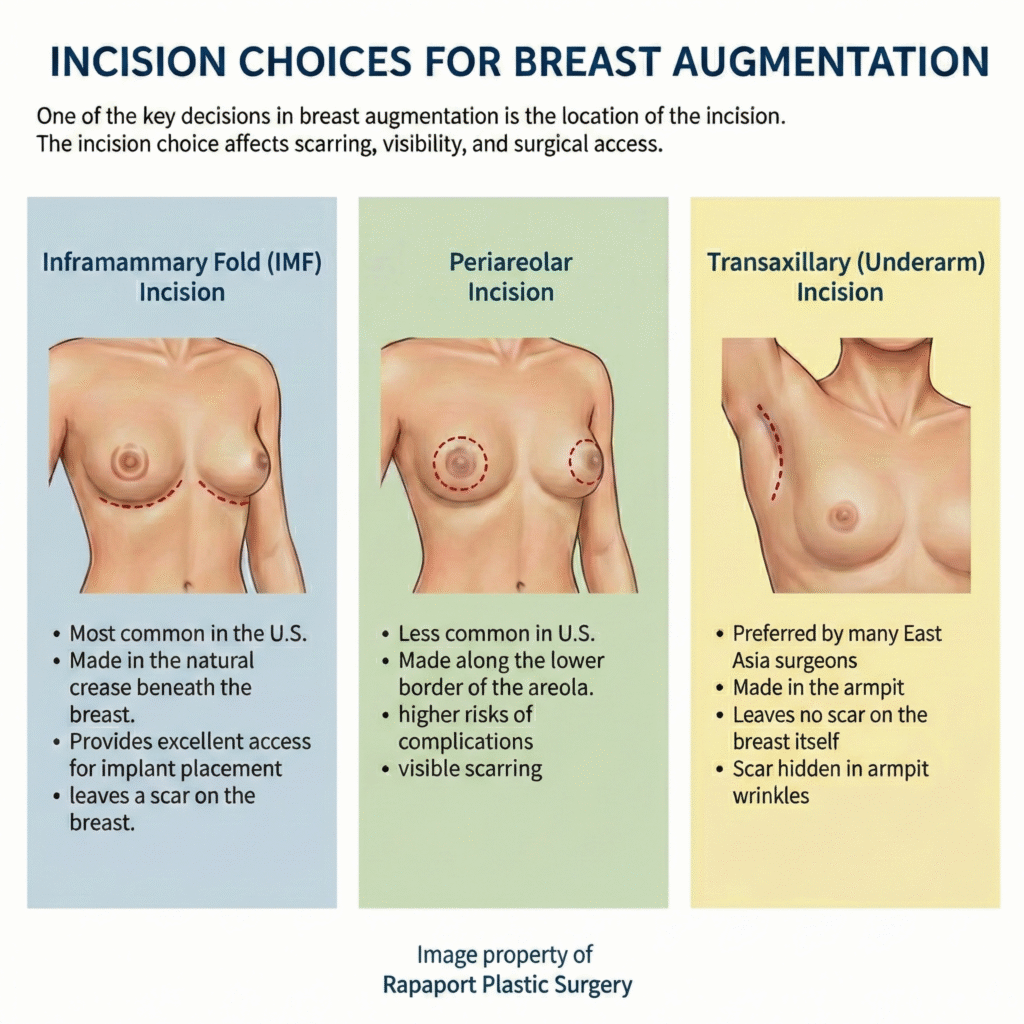
One of the key decisions in breast augmentation is the location of the incision. The incision choice affects scarring, visibility, and surgical access.
Common Incision Options
There are three primary incision sites for breast implants:
- Inframammary Fold (IMF) Incision
- The most common incision in the United States (about 98%).
- Made in the natural crease beneath the breast.
- Provides excellent access for implant placement but leaves a scar on the breast.
- Periareolar Incision
- Made along the lower border of the areola.
- Has fallen out of favor in the U.S. over the past 20 years due to higher risks of complications such as capsular contracture and visible scarring.
- Transaxillary (Underarm) Incision
- Made in the armpit.
- Preferred by Dr. Rapaport and many surgeons in East Asia.
- Leaves no scar on the breast itself, making it cosmetically elegant.
- The armpit skin’s natural wrinkles hide the scar well.
Why the Underarm Approach Is Preferred in Asia and Growing in Popularity
Asian patients have a higher tendency to form thick, visible scars, which makes the inframammary or periareolar incisions less desirable. In countries like South Korea, Taiwan, and China, where breast augmentation is booming, the underarm approach is favored because it minimizes visible scarring and offers a discreet option for patients conscious of their appearance.
The Underarm Technique: Endoscopic Assistance
Using an endoscope (a small camera) allows surgeons to perform the underarm implant placement with precision, avoiding blind maneuvers and reducing complications. This technique ensures the implant is placed correctly and helps avoid implant malposition or damage.
The Dynamics of Breast Augmentation: What to Expect Over Time
A successful breast augmentation is not just about how the breasts look shortly after surgery but how they change over time.
Implant Position and Natural Appearance
- Implants sitting too high on the chest rarely look natural when the bra is off.
- Natural breasts have more fullness in the lower pole, with the nipple centered on the breast mound.
- Overfilling the upper pole can cause an artificial look that many find unattractive.
- Ideally, the nipple should be the “cherry on top,” centered on the breast mound, with a natural slope and fullness below.
Skin and Tissue Support
- Larger implants in patients with thin skin or weak tissue may cause the skin to stretch over time.
- Without proper support, implants can lead to stretch marks or sagging.
- Wearing appropriate support garments and choosing a size compatible with your skin envelope can reduce these issues.
Why Avoid the Periareolar Incision?
Two main reasons explain why the periareolar incision is less favored:
1. Increased Risk of Capsular Contracture
Capsular contracture is a complication where scar tissue around the implant tightens and hardens, sometimes making the breast feel rock-hard. Research shows a correlation between bacterial contamination and capsular contracture development.
The nipple area contains ducts that harbor bacteria even after sterilization. When the incision is made through this area, bacteria can enter the implant pocket, increasing the risk of infection and subsequent scar tissue buildup.
2. Bacterial Biofilms and Low-Grade Infection
Biofilms are layers of bacteria that adhere to implant surfaces, causing chronic low-grade inflammation without obvious infection symptoms. These biofilms are difficult to eradicate and contribute to capsular contracture.
Because the nipple ducts are a natural bacterial source, surgeons avoid incisions near this area to minimize contamination risk.
Surgical Techniques to Minimize Infection Risk
The No-Touch Technique
Developed in the past two decades, the no-touch technique aims to avoid direct contact between the implant and the patient’s skin or gloves to reduce bacterial contamination. This technique involves:
- Using a sterile sleeve or “teederm” to shield the nipple-areolar complex.
- Avoiding touching the implant with gloves or instruments that have contacted the skin.
By combining the no-touch technique with incisions away from the nipple, surgeons reduce capsular contracture rates and improve implant longevity.
Summary: Key Takeaways for Breast Implant Candidates
Select an Experienced Surgeon: Techniques like the endoscopic transaxillary procedure require skill and experience to ensure safety and optimal outcomes.
Understand Your Anatomy: Know your skin envelope, breast volume, nipple position, and base diameter. These factors critically influence implant selection and surgical planning.
Choose the Right Incision: The inframammary fold incision is most common in the U.S., but the transaxillary (underarm) approach offers scar-free results and is highly favored in Asia and by some surgeons in the West.
Avoid Periareolar Incisions: Due to higher risks of infection and capsular contracture, this approach has decreased in popularity.
Consider Long-Term Outcomes: Implant position and size affect not only immediate results but also how your breasts age over time. Proper sizing and support are essential.
If you’re interested in learning more about breast augmentation or setting up a consultation at our New York City office, contact us today!
Related Posts